Now Available for Immediate Delivery!
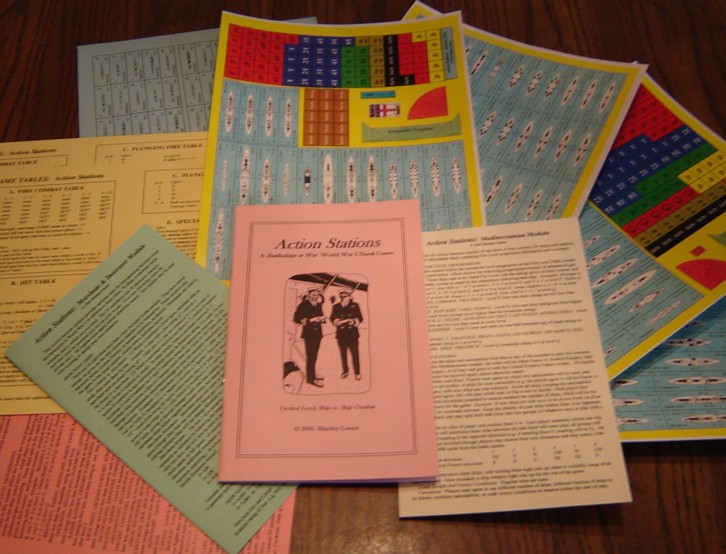
ACTION STATIONS is a tactical naval combat game which uses the BATTLESHIPS AT WAR game system, specially modified to account for capital ship warfare during World War I. The game comes with 20-page rulesbook, two Reference Cards, three "modules," 136 individually rated ships (in color on heavy stock), a sheet of 76 merchant ships/destroyers, game markers, and several scenarios. Ships from Britain, Germany, France, Italy, and Austria-Hungary are provided, and represent the dreadnought fleets of these countries.
ACTION STATIONS uses a series of "modules;" additional modules will be made available in the future, covering additonal countries (such as Russia, Turkey, the USA, etc.) and additional pre-dreadnoughts, armored cruisers, and light crusiers of all nations. As previously mentioned, the ACTION STATIONS game system is very like BATTLESHIPS AT WAR and THE MIGHTY HOOD (published in Panzerschreck #14), in that it simulates naval combat on a ship-to-ship basis using procedures familiar to miniatures, except that the game emphasizes playability... no endless lists of die-roll modifiers here! All the major game tables fit on a single 8.5" x 11" Reference Card. Each capital ship is individually rated for firepower (bow, broadside, and stern guns), flotation, armor, speed, and "special characteristics" involving fire control, deck armor, and the use of torpedoes. You'll be able to see, at a glance, the strengths and weaknesses of each ship. Most of the ships included are dreadnoughts and battlecruisers, although some pre-dreadnoughts, armored cruisers, and light cruisers are also provided. Scenarios include Dogger Bank, Coronel, Falklands, Goeben vs Battlecruisers, Jutland, Free Form Mediterranean (depending on whose side Italy joins), Merchant Raider, and, of course, Design Your Own options.
ACTION STATIONS includes the standard game plus the first three game modules. Players new to this type of wargaming may focus on the basic rulebook, which emphasizes battlecrusiers and smaller actions (such as Dogger Bank and Coronel). The Jutland 1916 module adds special rules and a Jutland scenario. The Mediterranean module does the same for countries bordering the Mediterranean Sea. Finally, the Merchant & Destroyer module provides new rules and scenarios involving merchant ships (including armed merchants), and rules for incorporating destroyers into scenarios. Everything you need to play is included; you may want to "expand your fleet" with the purchase of future modules, but even if you don't want to expand, Action Stations is a full, stand-alone game that will provide hours of World War I naval fun. As with BATTLESHIPS AT WAR and THE MIGHTY HOOD, ships must be mounted and cut out prior to play. Action Stations was designed by Gary Graber, editor of Panzerschreck magazine. For ordering information, click on the PRICES link below.
ACTION STATIONS compared with DREADNOUGHTS & BATTLECRUISERS
We now have two World War I naval games available. What are the differences between Action Stations and Dreadnoughts & Battlecruisers? A good, reasonable question! The main difference is D&B is a simpler game system... normally when one conducts fire combat, the result will be a "miss" or a "sunk" result. (There are exceptions, but this is generally true.) Action Stations has much more detail, in that there are four types of hits/damage that may occur: F (flotation), T (turret/firepower), D (deck), and S (superstructure). Certain hits are "exchanged" for another type of hit when enough are accumulated (e.g. two D hits turn into an additional F hit). Ships lose speed when they take F hits, and firepower when they take T hits. A "Special Damage Table" takes care of the rarer sorts of hits, in a realistic fashion. Barring a catastrophic hit, ships can take a lot of punishment before sinking... depending, of course, on the individual ship. In game terms, once a ship takes F damage that breeches its flotation rating, it sinks. It is fair to say that D&B plays more like the basic game (with refinements) of Avalon Hill's Jutland; Action Stations, while having more detail (even more so than Advanced Jutland), retains high playability. D&B has the advantage of having more ships included (345, from many countries); Action Stations currently has fewer ships, but each ship has more detail and ratings, and, along with the game markers, are produced in color instead of black & white as in D&B. D&B is great for newcomers to naval gaming, and can easily be played with very large scenarios. Action Stations, with more detail, will take longer to play, though smaller scenarios will also play extremely quickly. And no, the ships and ratings from each game are not compatible with one another; each game must use its own ships! Overall, it really is a matter of preference... D&B is not "out of date"; it is still an ideal introductory naval game, while Action Stations provides a game with more detail and depth for players who appreciate that sort of simulation. And, of course, we plan on offering expansion modules for Action Stations. Both games, however, retain the Minden philosophy of high playability coupled with historical insight. If you're a fan of World War I capital ship naval combat, you'll appreciate both games! After all, there's more than one route to having fun.
Game System "Great War Modifications" to ACTION STATIONS
Action Stations is similar to the Battleships at War game system, which covers World War II naval combat. What are the major changes? World War I ships largely operated in formations, and rules governing this is included. So, ships must maneuver in "line ahead" or "abreast ahead" type of formations. Only ships in the same "group" may combine fire on an enemy target. Instead of movement being by speed of each individual ship, movement order is now determined by the speed of each individual group of ships. There are modifications to the "smoke" rules to account for the increased smoke of WWI vessels, and ships of this era were more vulnerable to plunging fire, which is taken into account. Because of technology and construction techniques, you'll notice that Action Stations ships have slightly lower flotation and gunnery ratings than their Second World War counterparts. The addition of destroyers (and rules governing their use in flotillas) give the system an added dimension. Also included are several small, but significant, new optional rules, which may be employed as players' wish. Our goal is to provide (through expansion modules) a full set of Great War ships, down to the light cruiser level, from all the seafaring nations from around the globe. We're very pleased with what Action Stations has to offer, and are confident you will agree!